
Keys used in requests and responses
This section describes iproto keys contained in requests and
responses. The keys are Tarantool constants that are either defined or
mentioned in the iproto_constants.h file.
While the keys themselves are unsigned 8-bit integers, their values can have different types.
Name | Code and | Description |
|---|---|---|
0x54 | Binary protocol version supported by the client | |
0x55 | Supported binary protocol features | |
0x01 | Unique request identifier | |
0x05 | Version of the database schema | |
IPROTO_TIMESTAMP | 0x04 | Time in seconds since the Unix epoch |
0x00 | Request type or response type | |
0x52 | Error response | |
0x31 | Error as a string | |
IPROTO_DATA | 0x30 | Data passed in the transaction. Can be empty. Used in all requests and responses |
IPROTO_SPACE_ID | 0x10 | Space identifier |
IPROTO_INDEX_ID | 0x11 | Index identifier |
0x21 | Tuple, arguments, operations, or authentication pair. See details | |
IPROTO_KEY | 0x20 | Array of index keys in the request. See space_object:select() |
IPROTO_LIMIT | 0x12 | Maximum number of tuples in the space |
IPROTO_OFFSET | 0x13 | Number of tuples to skip in the select |
0x14 | Iterator type | |
IPROTO_INDEX_BASE | 0x15 | Indicates whether the first field number is 1 or 0 |
IPROTO_FUNCTION_NAME | 0x22 | Name of the called function. Used in IPROTO_CALL |
IPROTO_USER_NAME | 0x23 | User name. Used in IPROTO_AUTH |
IPROTO_OPS | 0x28 | Array of operations. Used in IPROTO_UPSERT |
IPROTO_EXPR | 0x27 | Command argument. Used in IPROTO_EVAL |
IPROTO_AUTH_TYPE | 0x5b | A protocol used to generate user authentication data |
IPROTO_AFTER_POSITION | 0x2e | The position of a tuple after which space_object:select() starts the search |
IPROTO_AFTER_TUPLE | 0x2f | A tuple after which space_object:select() starts the search |
IPROTO_FETCH_POSITION | 0x1f | If true, space_object:select() returns the position of the last selected tuple |
IPROTO_POSITION | 0x35 | If |
Name | Code and | Description |
|---|---|---|
0x0a | Unique stream identifier | |
IPROTO_TIMEOUT | 0x56 | Timeout in seconds, after which the transactions are rolled back |
0x59 | Transaction isolation level |
Name | Code and | Description |
|---|---|---|
IPROTO_REPLICA_ID | 0x02 | Replica ID |
IPROTO_INSTANCE_UUID | 0x24 | Instance UUID |
0x26 | The instance's vclock | |
0x5a | ID of the vclock synchronization request. Since 2.11 | |
IPROTO_REPLICASET_UUID | 0x25 | Before Tarantool version 2.11, IPROTO_REPLICASET_UUID was called IPROTO_CLUSTER_UUID. |
IPROTO_LSN | 0x03 | Log sequence number of the transaction |
IPROTO_TSN | 0x08 | Transaction sequence number |
0x01 | True if the instance is configured as read_only. Since 2.6.1 | |
0x02 | Current vclock of the instance | |
0x03 | Vclock of the instance's oldest WAL entry | |
0x04 | ||
0x05 | True if the replica is anonymous. Corresponds to replication.anon. Since 2.7.1 | |
0x06 | True if the instance has finished its bootstrap or recovery process. Since 2.7.3, 2.8.2, 2.10.0 | |
0x07 | True if box.cfg.election_mode is | |
0x08 | UUID of the bootstrap leader. The UUID is encoded as a 36-byte string. Since v. 2.11 | |
0x09 | An array of MP_STR elements that contains the UUIDs of members registered in the replica set. Each UUID is encoded as a 36-byte string. Since v. 2.11 | |
0x0a | The name of the instance Since v. 3.0 | |
0x09 | Auxiliary data to indicate the last transaction message state. Included in the header of any DML request that is recorded in the WAL. | IPROTO_SERVER_VERSION |
0x06 | Tarantool version of the subscribing node, in a compact representation | IPROTO_REPLICA_ANON |
0x50 | Optional key used in SUBSCRIBE request. True if the subscribing replica is anonymous | IPROTO_ID_FILTER |
0x51 | Optional key used in SUBSCRIBE request, followed by an array of ids of instances whose rows won't be relayed to the replica. Since v. 2.10.0 | IPROTO_REPLICASET_NAME |
0x5c | Optional key used to pass the initiator instance name in JOIN, SUBSCRIBE, and REGISTER requests. | IPROTO_INSTANCE_NAME |
Name | Code and | Description |
|---|---|---|
0x53 | RAFT term on an instance | |
IPROTO_RAFT_TERM | 0x00 | RAFT term on an instance. The key is only used for requests with the IPROTO_RAFT type. |
IPROTO_RAFT_VOTE | 0x01 | Instance vote in the current term (if any) |
IPROTO_RAFT_STATE | 0x02 | RAFT state. Possible values: |
0x03 | Current vclock of the instance | |
IPROTO_RAFT_LEADER_ID | 0x04 | Current leader node ID as seen by the node that issues the request Since version 2.10.0 |
IPROTO_RAFT_IS_LEADER_SEEN | 0x05 | True if the node has a direct connection to the leader node. Since version 2.10.0 |
All IPROTO_RAFT_* keys are used only in IPROTO_RAFT* requests.
Learn more about events and subscriptions in iproto.
These keys are used with SQL within SQL-specific requests and responses like IPROTO_EXECUTE and IPROTO_PREPARE.
Name | Code and | Description |
|---|---|---|
IPROTO_SQL_TEXT | 0x40 | SQL statement text |
IPROTO_STMT_ID | 0x43 | Identifier of the prepared statement |
IPROTO_OPTIONS | 0x2b | SQL transaction options. Usually empty |
0x32 | SQL transaction metadata | |
IPROTO_FIELD_NAME | 0x00 | Field name. Nested in IPROTO_METADATA |
IPROTO_FIELD_TYPE | 0x01 | Field type. Nested in IPROTO_METADATA |
IPROTO_FIELD_COLL | 0x02 | Field collation. Nested in IPROTO_METADATA |
IPROTO_FIELD_IS_NULLABLE | 0x03 | True if the field is nullable. Nested in IPROTO_METADATA. |
IPROTO_FIELD_IS_AUTOINCREMENT | 0x04 | True if the field is auto-incremented. Nested in IPROTO_METADATA. |
IPROTO_FIELD_SPAN | 0x05 | Original expression under SELECT. Nested in IPROTO_METADATA. See box.execute() |
IPROTO_BIND_METADATA | 0x33 | Bind variable names and types |
IPROTO_BIND_COUNT | 0x34 | Number of parameters to bind |
0x41 | Parameter values to match ? placeholders or :name placeholders | |
IPROTO_SQL_INFO | 0x42 | Additional SQL-related parameters |
SQL_INFO_ROW_COUNT | 0x00 | Number of changed rows. Is |
SQL_INFO_AUTO_INCREMENT_IDS | 0x01 | New primary key value (or values) for an INSERT in a table defined with PRIMARY KEY AUTOINCREMENT. Nested in IPROTO_SQL_INFO |
Code: 0x54.
IPROTO_VERSION is an integer number reflecting the version of protocol that the client supports. The latest IPROTO_VERSION is IPROTO_VERSION.
Code: 0x55.
Available IPROTO_FEATURES are the following:
IPROTO_FEATURE_STREAMS = 0– streams support: IPROTO_STREAM_ID in the request header.IPROTO_FEATURE_TRANSACTIONS = 1– transaction support: IPROTO_BEGIN, IPROTO_COMMIT, and IPROTO_ROLLBACK commands (with IPROTO_STREAM_ID in the request header). Learn more about sending transaction commands.IPROTO_FEATURE_ERROR_EXTENSION = 2– MP_ERROR MsgPack extension support. Clients that don't support this feature receive error responses for IPROTO_EVAL and IPROTO_CALL encoded to string error messages.IPROTO_FEATURE_WATCHERS = 3– remote watchers support: IPROTO_WATCH, IPROTO_UNWATCH, and IPROTO_EVENT commands.IPROTO_FEATURE_INSERT_ARROW = 12– support of data insertion in the Arrow format. Learn more about the feature. Available since version 3.3.0.
Code: 0x01.
This is an unsigned integer that should be incremented so that it is unique in every request. This integer is also returned from box.session.sync().
The IPROTO_SYNC value of a response should be the same as the IPROTO_SYNC value of a request.
Code: 0x05.
Version of the database schema – an unsigned number that goes up when there is a major change in the schema.
In a request header, IPROTO_SCHEMA_VERSION is optional, so the version will not be checked if it is absent.
In a response header, IPROTO_SCHEMA_VERSION is always present, and it is up to the client to check if it has changed.
Code: 0x14.
Possible values (see iterator_type.h):
| |
|---|---|
| |
| ALL, all tuples |
| LT, less than |
| LE, less than or equal |
| GE, greater than or equal |
| GT, greater than |
| BITS_ALL_SET, all bits of the value are set in the key |
| BITS_ANY_SET, at least one bit of the value is set |
| BITS_ALL_NOT_SET, no bits are set |
| OVERLAPS, overlaps the rectangle or box |
| NEIGHBOR, neighbors the rectangle or box |
Code: 0x0a.
Only used in streams. This is an unsigned number that should be unique in every stream.
In requests, IPROTO_STREAM_ID is useful for two things: ensuring that requests within transactions are done in separate groups, and ensuring strictly consistent execution of requests (whether or not they are within transactions).
In responses, IPROTO_STREAM_ID does not appear.
See Binary protocol – streams.
IPROTO_TXN_ISOLATION is the transaction isolation level. It can take the following values:
TXN_ISOLATION_DEFAULT = 0– use the default level frombox.cfg(default value)TXN_ISOLATION_READ_COMMITTED = 1– read changes that are committed but not confirmed yetTXN_ISOLATION_READ_CONFIRMED = 2– read confirmed changesTXN_ISOLATION_BEST_EFFORT = 3– determine isolation level automatically
See Binary protocol – streams to learn more about stream transactions in the binary protocol.
Code: 0x00.
The key is used both in requests and responses. It indicates the request or response type and has any request or response name for the value (example: IPROTO_AUTH). See requests and responses for client-server communication, replication, events and subscriptions, streams and interactive transactions.
Code: 0x52.
In case of error, the response body contains IPROTO_ERROR and IPROTO_ERROR_24 instead of IPROTO_DATA.
To learn more about error responses, check the section Request and response format.
Code: 0x31.
IPROTO_ERROR_24 is used in Tarantool versions before 2.4.1. The key contains the error in the string format.
Since Tarantool 2.4.1, Tarantool packs errors as the MP_ERROR MessagePack extension, which includes extra information. Two keys are passed in the error response body: IPROTO_ERROR and IPROTO_ERROR_24.
To learn more about error responses, check the section Request and response format.
Code: 0x21.
Multiple operations make use of this key in different ways:
Tuple to be inserted | |
|---|---|
Operations to perform | |
IPROTO_AUTH
Array of 2 fields: |
Code: 0x09.
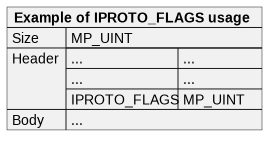
When it comes to replicating synchronous transactions, the IPROTO_FLAGS key is included in the header. The key contains an MP_UINT value of one or more bits:
- IPROTO_FLAG_COMMIT (0x01) is set if this is the last message for a transaction.
- IPROTO_FLAG_WAIT_SYNC (0x02) is set if this is the last message for a transaction which cannot be completed immediately.
- IPROTO_FLAG_WAIT_ACK (0x04) is set if this is the last message for a synchronous transaction.
Example:
Code: 0x53.
- The key is used in the IPROTO_RAFT_PROMOTE and IPROTO_RAFT_DEMOTE requests.
- Since version 2.11, the key is included in response to a heartbeat message. The term corresponds to the value of box.info.synchro.queue.term on the sender instance.
The vclock (vector clock) is a log sequence number map that defines the version of the dataset stored on the node. In fact, it represents the number of logical operations executed on a specific node. A vclock looks like this:
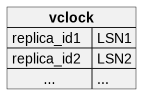
There are five keys that correspond to vector clocks in different contexts of replication. They all have the MP_MAP type:
- IPROTO_VCLOCK (0x26) is passed to a new instance joining the replica set.
- IPROTO_VCLOCK_SYNC (0x5a) is used by replication heartbeats. The master sends its heartbeats, including this monotonically growing key, to a replica. Once the replica receives a heartbeat with a non-zero IPROTO_VCLOCK_SYNC value, it starts responding with the same value in all its acknowledgements. This key was introduced in version 2.11.
- IPROTO_BALLOT_VCLOCK (0x02) is included in the IPROTO_BALLOT message. IPROTO_BALLOT is sent in response to the IPROTO_VOTE request. This key was introduced in /release/2.6.1.
- IPROTO_BALLOT_GC_VCLOCK (0x03) is also included in the IPROTO_BALLOT message. IPROTO_BALLOT is sent in response to the IPROTO_VOTE request. It is the vclock of the oldest WAL entry on the instance. Corresponds to box.info.gc().vclock. This key was introduced in /release/2.6.1.
- IPROTO_RAFT_VCLOCK (0x03) is included in the IPROTO_RAFT message. It is present only on the instances in the "candidate" state (IPROTO_RAFT_STATE == 2).
All IPROTO_BALLOT* keys are only used in the IPROTO_BALLOT requests. There have been the following name changes starting with versions /release/2.7.3, /release/2.8.2, and /release/2.10.0:
- IPROTO_BALLOT_IS_RO_CFG (0x01) was formerly called IPROTO_BALLOT_IS_RO.
- IPROTO_BALLOT_IS_RO (0x04) was formerly called IPROTO_BALLOT_IS_LOADING.
Code: 0x32.
Used with SQL within IPROTO_EXECUTE.
The key contains an array of column maps, with each column map containing at least IPROTO_FIELD_NAME (0x00) and MP_STR, and IPROTO_FIELD_TYPE (0x01) and MP_STR.
Additionally, if sql_full_metadata in the
_session_settings system space is TRUE,
then the array has these additional column maps which correspond to
components described in the box.execute()
section.
A bind variable (also called a parameter or a placeholder) is a token in an SQL statement that marks a spot for a value supplied separately from the statement text, instead of being written into the SQL string literally. Learn more about the general concept of bind variables in the SQLite documentation.
In Tarantool, a bind variable can be one of the following:
- A named bind variable always begins with
#,:, or@followed by a letter or another non-digit identifier character, for example:name,@name, or#name. - A numeric bind variable always begins with
$followed by a number, for example$1or$2. - An anonymous bind variable is denoted by
?followed by a non-numeric, non-alphabetic character, for example?.
See box.execute() for examples of using bind variables from Lua.
Code: 0x41.
Used with SQL within IPROTO_EXECUTE.
IPROTO_SQL_BIND is an array of parameter values to match the bind variables used in the SQL statement text. It can contain values of any type, including MP_MAP.
-
Values that are not MP_MAP replace anonymous (
?) and numeric ($N) bind variables, matched by position. -
MP_MAP values must have the format
{[name] = value}, wherenameis the named bind variable (for example,:name,@name, or#name) used in the request. Here is an example of such a request:tarantool> conn:execute('SELECT ?, ?, :name1, ?, :name2, :name1', {1, 2, {[':name1'] = 5}, 'str', {[':name2'] = true}})---- metadata:- name: COLUMN_1type: integer- name: COLUMN_2type: integer- name: COLUMN_3type: integer- name: COLUMN_4type: text- name: COLUMN_5type: boolean- name: COLUMN_6type: booleanrows:- [1, 2, 5, 'str', true, 5]