
Streams
The
Streams and interactive transactions
feature, which was added in Tarantool version 2.10.0, allows two things: sequential processing and
interleaving.
Sequential processing: With streams there is a guarantee that the server instance will not handle the next request in a stream until it has completed the previous one.
Interleaving: For example, a series of requests can include "begin for stream #1", "begin for stream #2", "insert for stream #1", "insert for stream #2", "delete for stream #1", "commit for stream #1", "rollback for stream #2".
To work with stream transactions using iproto, the following is required:
- The engine should be vinyl or memtx with mvcc.
- The client is responsible for ensuring that the stream identifier, unsigned integer IPROTO_STREAM_ID, is in the request header. IPROTO_STREAM_ID can be any positive 64-bit number, and should be unique for the connection. If IPROTO_STREAM_ID equals zero, the server instance will ignore it.
Name | Code | Description |
|---|---|---|
0x0e | Begin a transaction in the specified stream | |
0x0f | Commit the transaction in the specified stream | |
0x10 | Rollback the transaction in the specified stream |
Code: 0x0e.
Begin a transaction in the specified stream. See stream:begin(). The body is optional and can contain two items:
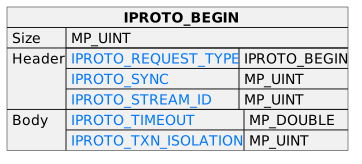
IPROTO_TIMEOUT is an optional timeout (in seconds). After it expires, the transaction will be rolled back automatically.
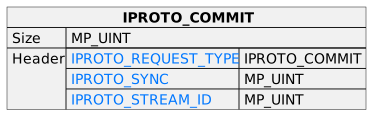
Code: 0x0f.
Commit the transaction in the specified stream. See stream:commit().
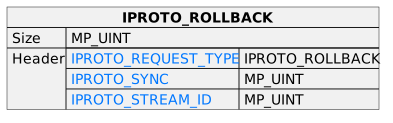
Codde: 0x10.
Rollback the transaction in the specified stream. See stream:rollback().
Suppose that the client has started a stream with the net.box module
net_box = require('net.box')conn = net_box.connect('localhost:3302')stream = conn:new_stream()
At this point the stream object will look like a duplicate of the conn
object, with just one additional member: stream_id. Now, using stream
instead of conn, the client sends two requests:
stream.space.T:insert{1}stream.space.T:insert{2}
The header and body of these requests will be the same as in non-stream IPROTO_INSERT requests, except that the header will contain an additional item: IPROTO_STREAM_ID=0x0a with MP_UINT=0x01. It happens to equal 1 for this example because each call to conn:new_stream() assigns a new number, starting with 1.
The client makes stream transactions by sending, in order:
- IPROTO_BEGIN with an optional transaction timeout in the IPROTO_TIMEOUT field of the request body.
- The transaction data-change and query requests.
- IPROTO_COMMIT or IPROTO_ROLLBACK.
All these requests must contain the same IPROTO_STREAM_ID value.
A rollback will happen automatically if a disconnect occurs or the transaction timeout expires before the commit is possible.
Thus, there are now multiple ways to do transactions: with net_box
stream:begin() and stream:commit() or stream:rollback() which
cause IPROTO_BEGIN and IPROTO_COMMIT or IPROTO_ROLLBACK with the current
value of stream.stream_id; with box.begin() and
box.commit() or box.rollback(); with SQL
and START TRANSACTION and COMMIT
or ROLLBACK. An application can use any or all of these
ways.